Curaçao Casino Licences for Australian Players
 Available in AU
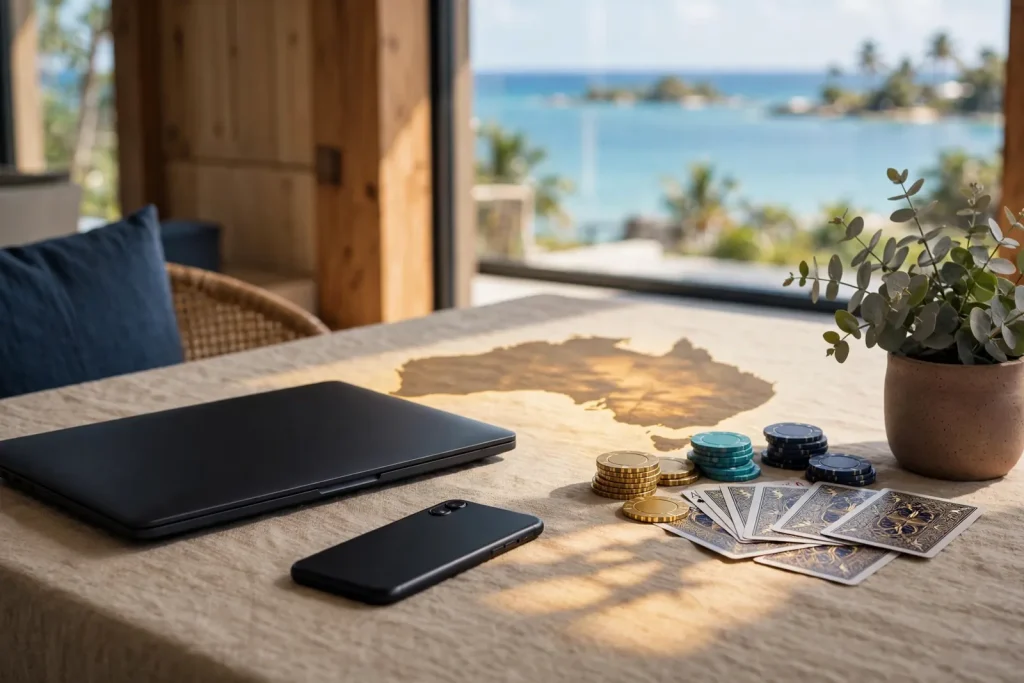
A site’s availability, currency options and Curaçao claims do not by themselves show that it is authorised to offer casino games in Australia.
Table of Contents
- What “online casino” means for Australian players
- A Curaçao licence is not an Australian licence
- What ACMA can do about prohibited offshore services
- How to check claims without relying on a casino’s sales pitch
- Casino games and the Australian rules
- Can you call an offshore casino safe?
- Crypto claims do not settle the licensing question
- The 2026 question: check the rules, not the year in a headline
- Why a “new” casino label is no safety check
- Does Curaçao have casinos? What the available facts can—and cannot—answer
What “online casino” means for Australian players
When you see “online casino”, it can sound like a simple description: a website where people can play casino games. But for someone in Australia, two different things are being bundled together. A site may be available through the internet, while its operator is not authorised to provide those games to people here. One is about access; the other is about the law.
I used to treat a page loading normally as a kind of quiet approval. If a site had Australian dollars in its menus and let me create an account, I assumed it must have been meant for Australian players. That was an easy assumption, and a poor one. A website can be visible, reachable, and written for an international audience without being authorised to offer its services in Australia.
That distinction matters with searches for an online casino linked to Curaçao, too. The words on a site, its location, and the fact that you can open it from Australia do not answer the legal question on their own. A name or label is not the same thing as permission to provide casino games here. It is worth separating what a site says about itself from what Australian law allows its operator to do.
If you’re considering a Curaçao-licensed casino as an Australian player in 2026, this list gives you a concise reference for the details available about each operator. Check the operator’s current terms and whether it accepts players from Australia before signing up.
1. Vegaz Casino
License: Curacao OGL/2024/1335/0780 · Min. deposit: EUR 20 Vegaz Casino lists Curaçao licence OGL/2024/1335/0780 and a minimum deposit of EUR 20. These details give you a clear starting point for checking its terms.
2. SpinsUp
License: Curacao Gaming Control Board OGL/2023/174/0082 (Dama N.V.) SpinsUp is listed with Curaçao Gaming Control Board licence OGL/2023/174/0082, held by Dama N.V. You can use the licence reference when reviewing the operator’s information.
3. Uptown Pokies
License: Curacao (operating since 2017) · Min. deposit: A$20 Uptown Pokies is described as operating since 2017 and has a minimum deposit of A$20. Its Curaçao licensing is also noted.
4. Playfina Casino
License: Curacao eGaming (Hollycorn N.V., since 2017) · Min. deposit: A$20-30 (depends on the offer) Playfina Casino is associated with Curaçao eGaming and Hollycorn N.V., with operations dating to 2017. Its minimum deposit is A$20–30, depending on the offer.
5. DragonSlots Casino
License: Curacao Gaming Authority (Jumpman Gaming Ltd) DragonSlots Casino is listed under the Curaçao Gaming Authority, with Jumpman Gaming Ltd named in connection with its licence. Check the operator’s own information for the applicable terms.
6. Kingmaker
Payout speed: crypto ~90 minutes, fiat 1-5 days · Min. deposit: A$30 Kingmaker’s listed payout timing is around 90 minutes for crypto and 1–5 days for fiat. Its minimum deposit is A$30.
7. Thor Casino
License: Curacao – Antillephone N.V. (Versus Odds B.V.) · Min. deposit: EUR 20 Thor Casino is listed with a Curaçao licence from Antillephone N.V., associated with Versus Odds B.V. Its minimum deposit is EUR 20.
8. JeetCity Casino
License: Curacao eGaming (Dama N.V.) JeetCity Casino is listed as Curaçao eGaming licensed, with Dama N.V. named in connection with the licence. This gives you a specific licensing detail to check when researching the casino.
9. Rollero Casino
License: Curacao Gaming Control Board OGL/2023/176/0095 (Hollycorn N.V.) Rollero Casino is listed with Curaçao Gaming Control Board licence OGL/2023/176/0095, held by Hollycorn N.V. You can refer to that number when checking its licensing information.
10. Roby Casino
License: Curacao eGaming (Roby Games Ltd) Roby Casino is listed as Curaçao eGaming licensed, with Roby Games Ltd named in connection with the licence. The available details focus on its licensing.
The relevant law is the Interactive Gambling Act 2001. It prohibits domestic operators from offering online casino games to Australian residents. That means the “online” part of the phrase does not make the service automatically lawful for the Australian market. A site can operate across borders and still fall outside what an operator may offer to people in Australia.
This is where the language gets slippery. “Available in Australia” might mean only that a page opens on your device. “For Australian players” can be a marketing phrase, a setting in an account, or a reference to accepting customers from here. None of those descriptions, by itself, establishes that the operator is authorised under Australian law. Access is a technical fact. Authorisation is a legal one.
I find it helps to slow down whenever those ideas get blurred. A site may display Australian currency or mention local customers, but those details do not change the basic distinction. Nor does the fact that an operator is based offshore answer whether it may offer online casino games to people physically in Australia. The issue is not whether the internet can connect you to the page. It is whether the service is permitted to be offered here.
The word “casino” can also cover different things in ordinary conversation. Someone might mean a physical venue, a game on a phone, a site that takes deposits, or a page advertising games. It is not enough to say that the site exists somewhere else or that its games are delivered digitally. The Australian rule concerns what operators offer to residents here.
$2 Minimum Deposit Casinos in Australia: What to Check
There is a separate point about the person visiting the site. The Interactive Gambling Act 2001 does not explicitly make individual players criminally liable simply for using an offshore casino site. That is not the same as saying an operator is allowed to offer the service, or that access turns the activity into an authorised Australian product. Those are different questions, and mixing them up makes a confusing subject worse.
I would not use “I can open it” as a shortcut for “it is legal here”. It is a tempting shortcut because the screen gives immediate feedback: the homepage appears, the games load, and the site may address you directly. But a working website tells you about connectivity, not the operator’s legal status. The internet is good at making distant services feel local. The feeling can be misleading.
So when a page describes itself as an online casino for Australians, read that as a claim about its audience, not as proof of Australian authorisation. The same goes for casino sites associated with Curaçao or any other offshore location. The words may tell you how the operator presents the service; they do not, by themselves, settle what Australian law permits.
That is the distinction to keep in view: being able to reach an online casino is not the same as an operator being authorised to offer casino games in Australia. A page can be reachable and still not be an authorised Australian service. Two different questions.
$5 Minimum Deposit Pokies in Australia
A Curaçao licence is not an Australian licence
A casino may display a Curaçao licence and still not be licensed in Australia. Those are two different claims, tied to different jurisdictions. The word “licensed” can sound like a universal stamp of approval; it isn’t. A licence issued offshore does not become an Australian licence just because a site accepts Australian visitors or uses Australian currency.
That distinction is easy to blur when a casino’s own page puts a licence badge beside phrases such as “trusted” or “internationally regulated”. Those are sales words. The relevant question is narrower: does that licence establish that the service is authorised under Australian law? A Curaçao licence, by itself, does not.
I used to treat a licence logo as if it settled the whole matter. It doesn’t. It tells you what the operator claims about its status in another jurisdiction. It does not answer whether the service holds an Australian licence, and it does not change the rules that apply in Australia. One country’s licensing framework cannot simply stand in for another’s.
What the licence claim does—and does not—tell you
If a site says it has a Curaçao licence, read that as a claim about offshore licensing. Don’t silently translate it into “licensed in Australia”. The two descriptions are not interchangeable, even if the site presents them together or makes the offshore licence prominent.
$1 Minimum Deposit Casinos in Australia: What It Means
That matters because a licence is not a general permission to provide every gambling product everywhere. A regulator’s authority is connected to its own jurisdiction and the rules that apply there. An offshore licence may be relevant to the operator’s status where it was issued, but it does not establish Australian authorisation.
Nor does the presence of a licence badge tell you that an Australian regulator has checked or approved the site. A logo on an operator’s page is not the same thing as confirmation in an Australian public register. I now separate those ideas before I give the badge any weight. Basic distinction. Big difference.
ACMA is Australia’s primary regulator for online gambling. Australians are encouraged to use ACMA’s public register to check whether a wagering service holds a valid Australian licence. That is the relevant place to look for an Australian licensing claim, rather than relying on a casino’s own description of an offshore licence.
There is an important limit to what that check means. A wagering licence entry is not a blanket approval for every gambling product, and it does not turn a casino licence from Curaçao into an Australian one. The register helps you verify an Australian wagering licence; it should not be read as a general endorsement of an offshore casino or as proof that online casino games are authorised.
Check the jurisdiction, not just the badge
When you encounter the phrase “Curaçao casino licence”, keep the jurisdiction attached to it. Ask yourself: whose licence is being claimed, and what does that establish in Australia? If the answer only points to Curaçao, the claim has not shown that the operator is licensed in Australia.
Do
- Keep the jurisdiction attached to the license claim
- Check the ACMA public register for Australian status
- Verify the operator’s exact legal name
Don’t
- Translate an offshore license into an Australian one
- Rely on a license badge as a universal approval
- Use a casino’s own description as final proof
This is not a technicality about wording. It is the difference between a regulator’s licence in one place and authorisation under the law that applies to Australian customers. A site can be accessible from Australia without that access proving it is authorised here. Likewise, an offshore badge cannot fill the gap between those two things.
The same caution applies to phrases such as “international licence” or “regulated casino”. They can sound broad, but they do not identify an Australian licence. Look for the specific Australian licensing status and check it against ACMA’s public register. If the operator points only to a Curaçao licence, that answers a different question.
I would not treat the register as a way to find an Australian-licensed online casino. The distinction matters: Australian law does not authorise real-money online casino games simply because an operator has a licence elsewhere. The register is useful for verifying whether a wagering service holds an Australian licence; it does not convert offshore casino licensing into local permission.
So, if you came across a casino Curaçao licence while checking a site, keep the conclusion modest. It may describe the operator’s offshore licensing claim. It does not establish that the operator is licensed in Australia. For that separate question, consult ACMA’s public register and keep the product in view: a wagering licence is not the same thing as authorisation to offer online casino games.
What ACMA can do about prohibited offshore services
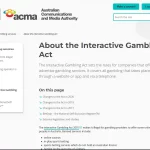
An offshore casino’s website can look like any other site: pages load, games are displayed, and the operator may say it holds a Curaçao licence. That does not put the service beyond Australian regulation. For online gambling, ACMA’s role is to enforce the Interactive Gambling Act 2001, including action against operators that breach it.
Low-Deposit Online Casinos in Australia
One tool ACMA can use is asking internet service providers to block access to a website. The request may concern a site offering prohibited interactive gambling services to Australian customers, or an unlicensed service offered to adults in Australia. In practice, that means ACMA can seek to make a site harder to reach from Australia through participating providers.
The wording matters: ACMA can request a block. It is not the same as saying that every offshore website disappears at once, or that a blocked site cannot be reached by anyone. A block is an enforcement measure directed at access to a website, not proof that the operator has shut down or that the service has changed its conduct. Don’t confuse a loading error with a complete account of what has happened.
I’ve learned not to treat a site’s continued availability as a legal endorsement. The reverse is true too: seeing a blocking notice tells you something about access, but it is not a personal ruling on every player or every transaction. ACMA’s action is about services and compliance, not a recommendation of where to gamble.
Blocking is one enforcement tool
A request to providers can affect what a visitor in Australia sees when trying to open a website. If a site becomes inaccessible on one connection, that does not establish that the operator has voluntarily left the market. It may reflect a block being applied. Nor does it establish that the site is safe or suitable; those are separate questions.
ACMA can request that internet service providers block access to websites offering prohibited interactive gambling services or unlicensed services to adults in Australia.
The measure is relevant to searches for Curaçao-licensed casinos because an offshore licence claim does not itself prevent ACMA from acting under Australian law. A licence issued elsewhere does not give an operator immunity from Australian rules. ACMA’s focus is whether the service falls within the law it enforces, not how confidently the website presents its licence details.
That distinction can get lost in casino marketing. “Licensed” sounds like a single global status, when a regulator’s authority and a licence apply within particular legal settings. A website can make a licensing claim and still face access restrictions in Australia. The claim and the block are different pieces of information. Neither should be used to infer more than it actually shows.
A block also does not necessarily settle what an operator will do next. ACMA’s action concerns access to the service, while any continued operation or change to the website is a matter for the operator. I wouldn’t read a fresh domain, a new page, or a different address as evidence that the underlying legal position has changed. A new coat of paint is still paint.
Fines target operators
Website blocking is not ACMA’s only power. ACMA can also issue fines to operators that breach the Interactive Gambling Act 2001. That makes the regulator’s role broader than simply responding when a website is reported or becomes difficult to access: enforcement can involve consequences for the operator as well as efforts to block access.
Casinos Not on BetStop in Australia: What to Know
The important boundary is who these measures are aimed at. The stated powers here concern operators and internet access providers; they are not a claim that ACMA fines individual players for visiting an offshore casino. The Act does not explicitly criminalise individual players for using offshore casino sites. That is not an endorsement of playing, and it does not turn a prohibited service into a lawful one. It is simply a distinction between enforcement against a service and the legal position of the person who encounters it.
I used to take a live website as a sign that somebody must have checked it and approved it. That was an easy assumption, and a bad one. Availability is not authorisation. A site may still appear online while ACMA takes action, and a block request does not function as a consumer-safety certificate.
So, when you see a Curaçao licence claim alongside Australian access, keep the two facts separate. The licence is the operator’s claim about another jurisdiction; ACMA’s powers come from Australian law. ACMA may ask providers to block a prohibited service and may fine operators that breach the Act. Neither step turns an offshore licence into permission to offer online casino gambling in Australia.
That’s the practical point: enforcement can restrict access and target operators, but a web page’s presence, disappearance, or polished licence badge cannot tell you by itself what ACMA has done or whether the service is authorised. Check the regulator’s information rather than treating the site’s own wording as the final word. And don’t mistake a block for a recommendation.
How to check claims without relying on a casino’s sales pitch
When a site calls itself “licensed”, that word is only a starting point. I’d want to know who issued the licence, which company holds it and what activity it covers. A badge in a footer is not the same as independent confirmation. Neither is a polished page headed “about us”.
Verifying Casino Claims
- Identify the issuing authority of the license
- Cross-reference the legal company name with ACMA’s register
- Verify the license number on the official regulator’s website
- Confirm the license covers the specific games being offered
For Australian authorisation, start with ACMA’s website and public register. ACMA has urged people to use its website and the national register to understand which gambling products are legal in the Australian market. Check the operator’s exact legal name against the register rather than relying on a brand name, logo or a link supplied by the casino itself.
Then read the entry carefully. A wagering licence is not a blanket approval for every gambling product that a business might advertise. Finding a name in a register does not, by itself, prove that the site is authorised to offer online casino games to people in Australia. That distinction is easy to miss when a page uses broad phrases such as “fully licensed” or “regulated worldwide”.
If the site displays a licence number, verify that number on the relevant regulator’s official website. Check that the number and company name match, and that the stated licence relates to the service being promoted. If the number cannot be confirmed, belongs to another business, or is presented without enough detail to check, walk away. A screenshot or certificate hosted by the casino is still the casino’s own claim.
This is where searches for Curaçao casino sites or a curated list of Curaçao-licensed casinos can mislead. A list may tell you which operators claim an offshore licence; it cannot turn that licence into Australian authorisation. The same goes for awards, review scores and phrases like “trusted” or “top-rated”. Those may sound reassuring, but they do not answer the legal question you need answered.
I’ve learned not to let a confident sales page rush me past the boring part. Match names. Check the register. Read what the licence actually covers. If the site makes it hard to identify the operating company or verify its claims, that is a reason to stop—not a puzzle you need to solve on its behalf.
Keep the practical consequences in view, too. An unlicensed gambling service does not provide the protections attached to an authorised Australian service, and Australian law may not help if it withholds winnings. Don’t use a VPN to get around access restrictions: doing so may lead to voided winnings, account closure and losing your deposit. That is a poor trade for a site whose status you could not establish.
No Minimum Deposit Casinos in Australia: How It Works
A check is not a recommendation. It is a way to separate a claim from something you can verify. If the only evidence is the casino’s own wording, you have not confirmed Australian authorisation. Stop there.
Casino games and the Australian rules
The important distinction is the game being offered, not the wording around it. A site may describe itself as a gaming club, a casino, or a place to play online, but those labels do not change the rules for casino games offered to people in Australia.
Online slots are among the games that operators cannot legally provide to Australian residents. Blackjack is another clear example. The restriction is about real-money online casino gaming, rather than whether a game has a familiar name, polished graphics or a Curaçao connection. A slot does not become a different kind of service because it is presented as a themed game; blackjack does not become something else because it is dealt through a screen.
$1 Minimum Deposit Pokies in Australia: What to Know
I used to get caught up in the surface details: the game lobby, the table layout, the little signs that made a site feel established. None of that answers the basic question of whether the games themselves may be offered here. The plain version matters more than the presentation.
That also means it is worth reading casino descriptions carefully. Terms such as “social”, “gaming” or “entertainment” can sound softer than “online casino”, but the name alone does not settle what is actually being offered. If the service involves online slots or blackjack for real money, the Australian restriction is relevant. A different label does not make the game lawful to offer.
Nor does it say that the Australian law explicitly criminalises an individual player for visiting an offshore site. The key point is narrower: operators are prohibited from providing online casino games to people in Australia.
So when a site promotes slots or blackjack to an Australian audience, the game menu is not a harmless detail to skip over. It is central to understanding the service. I learned to look past the banners and ask what is actually being offered. The answer can be very simple. The branding is not the rule.
Can you call an offshore casino safe?
I used to treat a padlock icon as a quiet little vote of confidence. It tells you the connection is encrypted; it does not tell you who is behind the site, whether its promises will be honoured, or what help you can get if something goes wrong. SSL encryption can protect information sent between you and a casino. That is useful, but it is a technical measure, not a safety certificate.
Secure Online Casinos in Australia: What to Know
The same goes for polished pages, identity checks or a support chat that answers quickly. None of those, on its own, gives you the protections attached to a service authorised in Australia. An offshore licence is not the same thing as being licensed in Australia, and a site displaying one should not be treated as locally authorised just because it looks professional.
That distinction matters if a site withholds winnings or closes an account. Unlicensed gambling services do not provide the consumer protections associated with authorised services, and Australian laws may not help you recover money in a dispute. A VPN is not a fix: using one to reach a casino may lead to winnings being voided, an account being closed and your deposit being lost. Not worth the gamble.
There is another part of safety that is easy to overlook when you are focused on the site itself. Reputable platforms provide information about gambling-related harm and direct people to professional support services across Australia. Take that seriously. If a platform makes no useful mention of harm or support, that absence should make you pause; a responsible-sounding slogan is not the same as practical help.
So, are Curaçao casinos safe? The country named in a licence does not settle that question. Encryption may protect a connection, but it cannot establish that a site is trustworthy, provide Australian consumer protection or make an offshore casino authorised here. Those are different issues.
Financial Risk
Using a VPN to bypass access restrictions may lead to voided winnings, account closure, and the loss of your deposit.
My rule now is less glamorous than the sales pitch: don’t confuse a secure connection with a safe service. Check what protection actually applies before sharing personal details or money, and step away if the site’s claims cannot be verified. A padlock is only a padlock.
Crypto claims do not settle the licensing question
A crypto logo can make a casino look modern, borderless or independent. It tells you nothing about whether the operator is allowed to offer online casino games to people in Australia. A payment option is not a licence, and a marketing claim does not change that.
I’ve learned to separate the pitch from the thing it is supposed to prove. Words such as “top” or “crypto-friendly” are selling points, not evidence of Australian authorisation. Even a detailed page about a Curaçao licence addresses the operator’s claimed status in that licensing jurisdiction; it does not establish that the operator is licensed in Australia.
That distinction matters because the Australian rule is about the service being offered, not the branding or payment method attached to it. Under the Interactive Gambling Act 2001, operators cannot provide real-money online casino games to people in Australia. A crypto payment claim does not create an exception. Nor does it turn an offshore casino into a service licensed in Australia.
I would not treat the presence of crypto, or any promise about how a payment works, as a shortcut to deciding whether a site is lawful here. The same goes for claims about speed, privacy or ease: unless you can verify the relevant point, it remains a claim. And none of those features answers the licensing question.
$20 Minimum Deposit Pokies in Australia: What to Check
If you are looking at a casino with a Curaçao connection, keep the questions separate: what does the operator say about its licence, and is it licensed in Australia? The first answer cannot substitute for the second. A payment page can describe a transaction; it cannot establish Australian authorisation.
That’s the dividing line. A coin is not a licence.
The 2026 question: check the rules, not the year in a headline
A Curaçao licence does not change the Australian legal position in 2026. Under the Interactive Gambling Act 2001, operators must not offer online casino games to Australian residents. A date in a site’s headline, a “new for 2026” label or a claim that its licence has been renewed does not create permission to serve people in Australia.
I used to read a licence badge as if it answered every question. It doesn’t. It may describe the operator’s status in the jurisdiction named on the badge, but it does not make that operator licensed in Australia or override Australian law. The important distinction is between what the law says about an operator offering the service and what it says about an individual who might use an offshore site.
The Act does not explicitly criminalise individual players for using offshore casino sites. That is not the same as saying an offshore casino is authorised to offer its games here. Nor does the absence of an explicit player offence turn an offshore licence into Australian approval. Two separate points. Easy to blur.
So if you are asking whether a Curaçao-licensed online casino can lawfully offer casino games to Australians in 2026, the year does not alter the answer: the Australian rule is about the operator’s offer to residents. If you are asking whether an individual player is explicitly criminalised by that Act for using such a site, the Act does not say that.
Highest Payout Online Casino Australia: What RTP Means
I would not let a dated banner collapse those two questions into one. “Licensed” can sound like a universal green light; it is not. The place that issued a licence matters, and so does the law where the service is being offered. In Australia, the operator’s offshore paperwork does not supply local authorisation. Check the legal distinction, not the headline’s calendar.
Why a “new” casino label is no safety check
A fresh design can make a casino site feel like a clean slate. I know the pull: a new name, tidy pages and a promise of a better experience can look more convincing than an old site you already distrust. But “new” describes how a site presents itself, not whether it is authorised to offer gambling in Australia.
That distinction matters with searches for new Curaçao casinos. A recent launch or a new-looking brand does not change the Australian rules for operators, and it does not tell you what ACMA has done about a particular service. A polished homepage is not a regulator’s decision. Not even close.
ACMA’s blocking activity gives some context for why a site’s appearance is a poor guide. Since its first blocking request in November 2019, the regulator has restricted access to 1,369 illegal gambling and affiliate websites. That figure covers a broad group of websites; it is not a count of newly launched casinos, nor a verdict on every site carrying a Curaçao connection.
Blocking is part of enforcement, not a badge system for shoppers. A site being visible today does not prove that it has been assessed as lawful or that it will remain accessible. And a site that looks newly built is not necessarily a new operator or a new service. The label alone settles none of that.
$10 Minimum Deposit Pokies in Australia: What to Know
I’ve learned to distrust the word “new” when it is doing the work of evidence. It can be a marketing hook, not a meaningful status. The useful question is not whether a site looks fresh, but whether its claims stand up against the rules and regulator information. That is a less exciting check. It is also the one that matters.
Fresh paint. Same question.
Does Curaçao have casinos? What the available facts can—and cannot—answer
“Casinos in Curaçao” can mean two different things: gambling venues physically on the island, or online services associated with Curaçao. The wording alone does not tell you which one someone means. I’ve learned not to let a familiar label do more work than it can.
A question about land-based venues needs information about physical businesses and local rules. An online casino’s licence claim, by contrast, is about the operator and its regulatory arrangements. Neither tells you, by itself, what gambling services may legally be offered to people in Australia.
For Australians, the relevant point is the local law. The Interactive Gambling Act 2001 makes it illegal for operators to provide real-money online casino games to people in Australia. That position does not change because a website uses Curaçao in its name, presents itself as connected with the island, or refers to an offshore licence. A location or licensing label is not permission to offer casino games here.
I used to treat a polished website and a confident badge as if they answered every question. They don’t. Keep the questions separate: what venues may exist in Curaçao, what an online operator’s licence covers, and whether a service can legally provide casino games to Australians. Those are not interchangeable claims.
What I can say is that the existence of land-based venues, if any, would not settle the Australian legal position on online casino services. Different place. Different question.
What are the legal consequences for Australian players using offshore casinos?
The Interactive Gambling Act 2001 does not explicitly make individual players criminally liable simply for using an offshore casino. However, that does not make the casino authorised to offer online casino games in Australia.
Which banking methods are available for deposits and withdrawals?
Methods may include PayID, e-wallets, bank transfers and cards. POLi is mainly for deposits, while card withdrawals may be slower or unavailable; check the casino’s cashier for its supported options.
What documents might be needed for verification?
You may be asked for photo identification, proof of address and proof that you own the payment method used. Casinos commonly require these checks before withdrawals.
How long should a withdrawal take from a secure casino?
PayID and some e-wallet withdrawals may arrive quickly after approval, with PayID often clearing within minutes once released. Bank transfers and card withdrawals can take several business days.
Casino Selection

$1 Minimum Deposit Casinos in Australia: What It Means
A stated threshold is not a playable balance: payment rules, fees and wagering terms can...

$1 Minimum Deposit Pokies in Australia: What to Know
An operator’s advertised deposit setting can differ from the payment method’s threshold, affecting whether a...
$10 Minimum Deposit Casinos in Australia
The casino’s stated minimum may not match the amount accepted by a payment provider, and...

$10 Minimum Deposit Pokies in Australia: What to Know
A low stated minimum does not guarantee every payment route accepts that amount or that...

$2 Minimum Deposit Casinos in Australia: What to Check
An operator’s cashier minimum and a payment method’s transaction floor are separate rules, and the...
$20 Minimum Deposit Casinos in Australia
A small deposit may be limited by the payment method as well as the casino,...
$20 Minimum Deposit Pokies in Australia: What to Check
A low advertised minimum can depend on the payment route, currency and bonus conditions, while...
$5 Minimum Deposit Casinos in Australia
A casino’s advertised minimum and a payment service’s limit can differ, so the cashier determines...

$5 Minimum Deposit Pokies in Australia
The casino’s stated minimum may differ from the amount its payment method or processor will...

Casinos Not on BetStop in Australia: What to Know
BetStop registration does not regulate offshore casinos, and access alone says nothing about licensing, deposits,...
Highest Payout Online Casino Australia: What RTP Means
RTP describes a game’s theoretical long-run return, not the result of a session or a...

Low-Deposit Online Casinos in Australia
A practical guide to comparing operator rules, payment limits, bonuses and withdrawal conditions before choosing...
Secure Online Casinos in Australia: What to Know
Security features and payment options cannot establish that an online casino is permitted to offer...
No Minimum Deposit Casinos in Australia: How It Works
A casino may set no deposit floor, while its payment method or processor still rejects...

Safe Online Casino Australia: Legal and Safety Guide
The Interactive Gambling Act 2001 prohibits Australian operators from offering online casino games, so polished...