Online Casino Payment Methods for Australians
 Available in AU
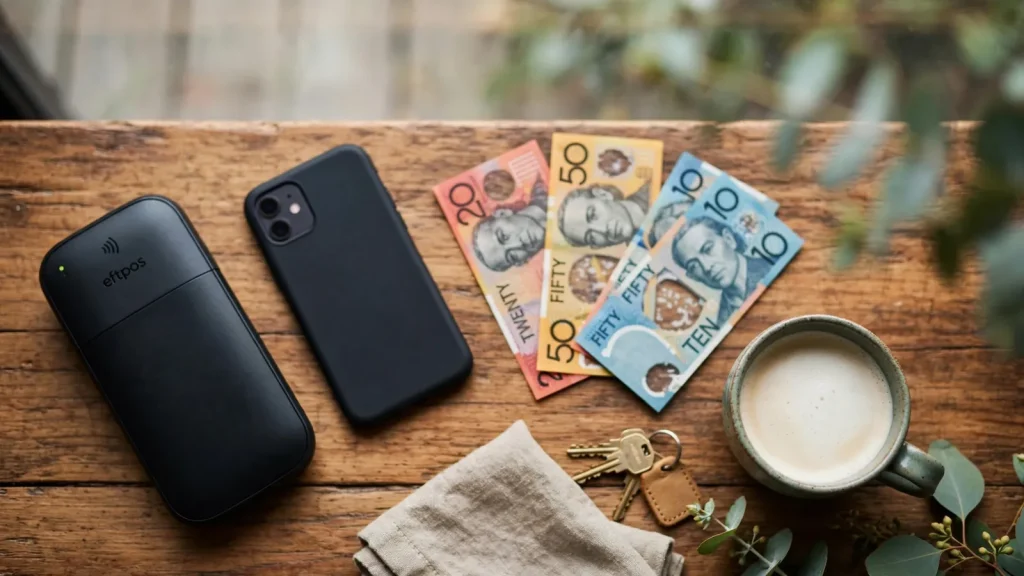
Payment labels can describe different routes, and a deposit option does not establish that the same method supports withdrawals.
Table of Contents
- Start With the Payment Route, Not the “Fast” Badge
- A Deposit Is Not a Withdrawal
- PayID and Bank Payments in the Australian Context
- What a Bank Transfer Can—and Can’t—Do
- Before Any Payment Goes Through, Expect Checks
- Prepaid Vouchers Have a Spending Ceiling—and a Catch
- Provider Fees Can Eat Into the Amount You Keep
- “Instant” Depends on the Payment Rail
- Wallet Apps Are Convenient for Deposits, Not Every Cashout
- Using PayID on Your Phone Still Needs a Cashout Check
Start With the Payment Route, Not the “Fast” Badge
Before comparing payment labels, there is a more important point for anyone physically in Australia: providing real-money online pokies, poker, or table games to people here is prohibited under the Interactive Gambling Act 2001. This is not a recommendation to use an offshore site.
I used to treat a “fast” badge as if it answered the only question that mattered. It doesn’t. A payment method can be quick at one stage and unsuitable at another, or appear in a menu without working for the transaction you have in mind. The useful starting point is the route: what kind of service handles the money, and whether it is being used to pay in or take money out.
The broad categories you may see include bank-linked payments, bank transfers, e-wallets, prepaid vouchers and digital currencies. Each describes a different way money may move, not a promise that a particular operator accepts it or supports every transaction with it. A specialist review notes that deposit and withdrawal menus can differ. So a method listed beside a deposit button should not be taken as evidence that you can later cash out through the same route. Check both sides before relying on any option.
When choosing an online casino payment method, you’ll want to check whether the available options suit your deposit and withdrawal needs. Use these details as a starting point, and verify payment methods and terms with each casino before you pay.
1. Vegaz Casino
License: Curacao OGL/2024/1335/0780 · Min. deposit: EUR 20 Vegaz Casino lists a minimum deposit of EUR 20. Its stated licence is Curacao OGL/2024/1335/0780.
2. SpinsUp
License: Curacao Gaming Control Board OGL/2023/174/0082 (Dama N.V.) SpinsUp’s stated licence is Curacao Gaming Control Board OGL/2023/174/0082, held by Dama N.V. Check the casino directly for its payment options and terms.
3. Uptown Pokies
License: Curacao (operating since 2017) · Min. deposit: A$20 Uptown Pokies lists a minimum deposit of A$20 and says it has operated since 2017. It states that it is licensed in Curacao.
4. Playfina Casino
License: Curacao eGaming (Hollycorn N.V., since 2017) · Min. deposit: A$20-30 (depends on the offer) Playfina Casino’s minimum deposit is A$20–30, depending on the offer. It states that it is licensed by Curacao eGaming and operated by Hollycorn N.V., which has been active since 2017.
5. DragonSlots Casino
License: Curacao Gaming Authority (Jumpman Gaming Ltd) DragonSlots Casino states that it is licensed by the Curacao Gaming Authority, with Jumpman Gaming Ltd as the operator. Check directly which payment methods and terms apply to you.
6. Kingmaker
Payout speed: crypto ~90 minutes, fiat 1-5 days · Min. deposit: A$30 Kingmaker lists a minimum deposit of A$30. Its stated payout times are around 90 minutes for crypto and 1–5 days for fiat.
7. Thor Casino
License: Curacao – Antillephone N.V. (Versus Odds B.V.) · Min. deposit: EUR 20 Thor Casino lists a minimum deposit of EUR 20. Its stated Curacao licence is through Antillephone N.V., with Versus Odds B.V.
8. JeetCity Casino
License: Curacao eGaming (Dama N.V.) JeetCity Casino states that it is licensed by Curacao eGaming, with Dama N.V. Check with the casino for payment methods and applicable terms.
9. Rollero Casino
License: Curacao Gaming Control Board OGL/2023/176/0095 (Hollycorn N.V.) Rollero Casino’s stated licence is Curacao Gaming Control Board OGL/2023/176/0095, held by Hollycorn N.V. Confirm its payment options and terms directly.
10. Roby Casino
License: Curacao eGaming (Roby Games Ltd) Roby Casino states that it is licensed by Curacao eGaming, with Roby Games Ltd. Check directly for the payment methods available to you.
Cards are a familiar example of why labels can mislead. Specialist reviews describe Visa and Mastercard deposits as instant, but that claim is not a guarantee that a transaction will go through. The same kind of review reports that many standard card payments to offshore casinos are blocked by Australian financial institutions. More importantly, credit cards are not an acceptable deposit option for online wagering in Australia. Don’t treat an attempted card payment as a workaround.
Digital currencies need the same clear boundary. Bitcoin and other cryptocurrency may appear in descriptions of offshore payment menus, but crypto is not an acceptable deposit method for online wagering in Australia. A search for Bitcoin payment details can surface information about casino transactions; that does not make those deposits permitted here. Nor should a fast-sounding transfer description distract from the fact that cryptocurrency transactions are irreversible and have no chargeback option.
E-wallets and prepaid vouchers are separate categories, too. An e-wallet holds or moves funds through its own service, while paying via a voucher means spending value loaded in advance. Bank-linked options and transfers involve a bank account, though they are not interchangeable simply because both touch a bank. For any method you encounter, the label alone tells you little about whether it is available for a particular transaction. A menu is not a guarantee.
Casino Sites That Accept Amex in Australia
That distinction matters more than a speed slogan. “Instant” can describe one step, not the entire journey from payment request to funds being available. Even where a payment method is named, the operator’s transaction process and the method’s own capabilities are separate pieces of the route. I’ve learned not to assume that a quick-looking deposit choice tells me anything reliable about a later cashout.
So read payment language as a description, not a promise. Separate bank-linked payments, transfers, e-wallets, vouchers and digital currencies in your mind, then ask what each is actually being used for. In Australia, keep the legal boundary in view as well: no payment method changes the status of prohibited online casino services. The “fast” badge is the easy bit. The route is what matters.
A Deposit Is Not a Withdrawal
I used to treat the cashier as a two-way door: if an option let me put money in, I assumed it would let me take money out too. That assumption is the sort of small mistake that can leave you staring at a balance you cannot move the way you expected.
A specialist review notes that the methods shown for deposits can differ from those offered for withdrawals. That is a description of one review’s findings, not a rule to rely on across operators. The practical point is simpler: the cashier may have separate lists for money going in and money coming out. Seeing a method in the deposit menu does not prove it is available for a cashout.
Do
- Find the withdrawal terms before any deposit
- Confirm which route is available to receive funds
- Verify if the operator requires the same account for both sides
Don’t
- Assume a deposit method is automatically a cashout method
- Rely on the deposit menu as evidence of withdrawal availability
- Assume the cashier will sort out unclear details later
Treat the two directions as separate decisions. Before any deposit, find the withdrawal terms and confirm which route is available to receive funds. Check whether the operator requires the same account or payment details for both sides, and whether the withdrawal menu offers a route you can actually use. If that information is unclear, do not assume the cashier will sort it out later.
That is the part I would now check before getting distracted by a “quick” deposit button. A payment can appear accepted at the first stage while the later cashout follows a different process. Your account balance is not the same thing as money already received in your bank or payment account. There can be steps between requesting a withdrawal and having funds available to you, and the terms determine what those steps are.
The label “no deposit” can also make an offer sound simpler than it is. It does not mean there are no conditions. A promotion may still require wagering before funds or winnings become withdrawable, ask for verification, or set other withdrawal conditions. Read the offer terms alongside the cashier terms; they answer different questions. One concerns what you must do to qualify for a withdrawal, while the other explains how a payment request can be handled.
I learned to look for the point at which promotional balance becomes withdrawable, rather than assuming that a displayed amount is ready to cash out. If the wording is hard to follow, or if a condition is not explained clearly, pause instead of treating the offer headline as the full deal. No guesswork.
Casinos That Accept Tether USDT in Australia
There is a wider issue for anyone in Australia: real-money online casino games, including pokies and table games, are prohibited interactive gambling services when provided to people here. The Interactive Gambling Act 2001 makes it unlawful for operators to provide those services to people physically located in Australia. This is not a suggestion to find an operator with a better cashier; the payment mechanics do not change the legal position.
For me, payment risk management starts before money moves: understand the route in, the route out, and the conditions that sit between them. Keep those questions distinct. A deposit method is not automatically a cashout method, and a promotional balance is not automatically withdrawable. If you cannot establish what happens after you click deposit, leave the transaction alone.
PayID and Bank Payments in the Australian Context
PayID is built around Australian bank accounts, not a separate balance that you have to top up first. The New Payments Platform lets an account holder link an identifier—such as a mobile number, email address or ABN—to their bank account. When a payment is made using that identifier, it points to the linked account. PayID is supported by every major Australian bank, which gives it broad local reach.
That reach does not mean every business accepts it, or that it works the same way wherever it appears. In particular, a payment option shown on a site does not establish that it is available for both sending and receiving money. A specialist review describes PayID as the primary Australian-dollar deposit method at most offshore operators it covers. Treat that as the review’s account of those operators, not a guarantee about the market or any particular service. Payment arrangements can change, and the operator’s own terms are the place to check what it currently supports.
Legal Warning
Under Australia’s Interactive Gambling Act 2001, it is illegal for operators to provide real-money online casino games to people physically in Australia.
There is also a legal point that matters more than a familiar payment logo. Under Australia’s Interactive Gambling Act 2001, it is illegal for operators to provide real-money online casino games, including pokies, poker and table games, to people physically in Australia. PayID’s connection to Australian banks does not make an offshore casino lawful or mean it is approved for local gambling. A payment rail and the legality of the service using it are separate things.
I used to treat a familiar local payment option as a kind of reassurance. That was a mistake. A bank-linked identifier can make the payment step feel ordinary, but it tells you nothing by itself about the operator, the terms attached to a transaction or whether a route back to your bank account is available. Don’t let a recognisable name do the checking for you.
If you encounter PayID in a gambling context, look at the operator’s current payment information before acting. Confirm whether it lists PayID for deposits, whether it separately lists it for withdrawals, and whether the name of the payment recipient matches the details the operator has given you. If the page is unclear, the payment option is missing from the withdrawal information, or the instructions change at checkout, stop rather than guessing. A deposit button is not evidence of a matching cashout route.
Trustly casino sites in Australia: what’s verified
The same distinction applies to Australian bank infrastructure more broadly. A service can use local bank accounts or payment rails without being an Australian-licensed casino. And the fact that PayID is supported by major banks does not mean a bank endorses every business that asks you to send money through it. The payment identifier handles the connection; it does not assess the gambling service for you.
So PayID’s local advantage is straightforward: it uses an identifier linked to an Australian bank account through the New Payments Platform. Its usefulness in any particular transaction depends on what the operator says it supports, and its familiarity should not be mistaken for a legal safeguard. Check both directions separately. Then decide whether proceeding is appropriate at all. A familiar rail is still only a rail.
What a Bank Transfer Can—and Can’t—Do
A bank transfer is not the route I’d pick when the point is to have money ready for a quick session. It can involve a delay at the casino end, especially when a withdrawal is handled in batches rather than released as soon as you request it. A specialist review describes an operator processing bank transfers manually once or twice a week; in its example, a Friday withdrawal request reached the bank by Wednesday. That is one operator’s reported schedule, not a timetable you can assume for every service.
Bank Transfer Limits
A specialist review presents bank transfer as an option for withdrawals above $10,000, where the slower process may be preferable to routes with different limits.
That lag is easy to misread. Your bank may be able to move funds promptly once a transfer is sent, while the casino has not yet approved or submitted the withdrawal. The bank only handles its part of the route. I’ve made the mistake of blaming the payment method for a wait that began before the payment was even on its way.
For a large cashout, the trade-off may look different. A specialist review presents bank transfer as an option for withdrawals above $10,000, where the slower process may be preferable to trying to move a substantial balance through a route with different limits or handling. Treat that as a reported use case, not a rule about what any operator will accept. The operator’s terms determine whether it offers bank withdrawals and how it handles them.
Fees need the same close reading. One specialist review reports flat bank-transfer charges of $5–$15 at casinos it examined, while describing crypto withdrawals as generally free there. Those details can change between operators, and a fee deducted from a cashout reduces what lands in your account. Don’t assume that a quoted transfer fee covers every charge in the route, or that another route is free simply because the casino lists no fee.
A payment gateway is a different part of the machinery. It routes payment information between the relevant parties and can help process a transaction; it does not decide when a casino reviews a withdrawal or puts it in a payment batch. So a polished online casino payment gateway, or a claim about advanced casino payment technology, cannot by itself make a slow cashout quick. The handoff and the operator’s schedule are separate things.
CashtoCode Casinos in Australia: What to Verify
That distinction matters when you see claims about a “fast” payment gateway. The phrase may describe transaction handling, not the time from pressing withdraw to seeing funds in your account. I’d look for the operator’s stated bank-transfer process and any listed fee before treating speed claims as useful. A gateway can route. It cannot set the casino’s cashout calendar.
There is also a legal limit to keep in view in Australia: the Interactive Gambling Act 2001 prohibits operators from providing real-money online casino services, including pokies and table games, to people in the country. These payment mechanics are not an endorsement or a way around that restriction. Don’t confuse how a transfer works with whether the underlying service may lawfully be provided here.
Slow, but clear.
Before Any Payment Goes Through, Expect Checks
A payment page can make the transaction look like a quick formality. The less glamorous part is proving who you are and, sometimes, that the payment method belongs to you. A specialist review describes operators asking for government-issued identification, proof of address dated within three months, and evidence of the payment method. That is a possibility to prepare for, not a promise that every operator will ask for the same documents.
The exact request can depend on the operator and the transaction. Identification might mean a document that shows your name and identity; address evidence needs to show where you live and fall within the stated date window. Payment-method evidence is a separate check: the operator may want to connect the account or instrument used for the transaction to you. Read the request carefully before sending anything. A document that proves your identity does not necessarily prove your address or payment ownership.
Document Preparation
- Prepare a government-issued identification document
- Obtain proof of address dated within the last three months
- Gather evidence of ownership for the payment method used
I used to think a payment was finished once the balance changed on screen. That was the wrong point to call it done. A later request for documents can interrupt the process, so it is worth knowing what the operator may ask for before you rely on a payment route. Keep your details consistent, and use the operator’s stated process to provide documents rather than sending them through an unrelated channel.
This is where talk of a “safe” payment system needs a bit of translation. A payment method and an identity check do different jobs. One moves money; the other helps an operator assess who is making the transaction and whether the payment method is connected to them. Neither label, by itself, proves that a service is safe or lawful for you to use. Don’t treat a polished cashier screen as a substitute for checking what service you are dealing with.
There is an important Australian context here: under the Interactive Gambling Act 2001, providing real-money online casino games to people in Australia is prohibited. An identity check does not change that. Nor does a document request turn an offshore service into an Australian-licensed casino. I would not confuse administrative paperwork with legal protection.
If you are asked for documents, check that the request comes through the operator’s own stated process and that you understand what each item is meant to verify. Don’t send extra personal information just because a message sounds urgent. If the requested evidence does not match the payment method you used, pause and clarify the request before proceeding.
A few minutes spent reading the conditions and the document request can prevent a nasty surprise later. Paperwork first.
Prepaid Vouchers Have a Spending Ceiling—and a Catch
A prepaid voucher puts a hard edge around what you can spend: the payment can draw only on the value loaded onto it. That can make the limit easier to see than when money comes straight from a bank account. It does not make the transaction risk-free, though, and it does not turn a voucher into a way to receive money back.
The catch is the cashout. A specialist review describes voucher deposits as generally not being returnable to the voucher itself. So if money is later eligible for withdrawal, you may need a different method to receive it. Before treating any prepaid option as workable, check whether the operator accepts it for deposits and what separate route, if any, applies to withdrawals. A payment button in a casino payment portal does not tell you the whole story.
I used to focus on whether a payment method would get money in. That was the easy half to inspect. The awkward bit was finding out what happened when I wanted money out. With a voucher, the loaded amount is a spending boundary; it is not a promise that the same instrument can carry funds back.
Attention: Prepaid voucher deposits are generally not returnable to the voucher itself, meaning you will need a different method to receive withdrawals.
That matters even if the voucher looks simple at checkout. You still need to understand the conditions attached to the transaction and whether you can use an acceptable cashout method. Do not assume that a prepaid voucher, including a Neosurf voucher, works in both directions just because it appears among payment choices. Availability and withdrawal arrangements are operator-specific.
There is also an important Australian context that a payment screen cannot erase: under the Interactive Gambling Act 2001, operators are prohibited from providing real-money online casino games to people physically in Australia. A voucher’s spending cap does not make an otherwise prohibited service lawful or provide a safeguard for funds sent to an offshore casino. I would not treat a payment option as an endorsement or a reason to proceed.
If you are comparing prepaid options in general, the practical distinction is straightforward: the loaded value can cap what is spent through that voucher, while any cashout may require another route. Keep those as separate questions. “Prepaid” describes how the amount is funded, not whether winnings or unused funds can be returned through the same channel.
A ceiling helps. It is not a cashout plan.
Provider Fees Can Eat Into the Amount You Keep
A payment method’s cost is not always shown beside the button you click. I’ve learned to separate the casino’s own charge from what the payment provider or currency conversion may take. The amount credited to an account and the amount that eventually reaches you can differ, even when the screen makes the transaction look tidy.
A specialist review reports that some casinos apply a 1–3% transaction fee to Skrill withdrawals to a bank. It also puts the bank-arrival time at 1–2 days. Those are reported terms, not a promise that every operator or Skrill account will work that way; check the fee and destination details for the specific transaction before relying on them. A percentage fee can matter more as the amount grows. Small print, real money.
Currency conversion is another separate cost. If a balance is converted from AUD to EUR, the conversion can cost 2–4%. That may be charged through the exchange rate rather than displayed as a line called “fee”, so compare the amount sent with the currency and amount you expect to receive. I used to look only for an obvious deduction. That misses the exchange rate.
Neteller has a reported 1.45% charge for credit-card funding, according to a specialist review. That is a provider fee detail, not a reason to fund online gambling with a credit card: credit cards are not an acceptable deposit route for online wagering in Australia. Keep that distinction clear when comparing payment-provider charges. A fee attached to a funding option does not make the option appropriate or available for gambling.
When you compare casino payment providers, write down each cost separately: any operator transaction fee, any provider fee, and any currency conversion. Then check which currency the balance is held in and where a withdrawal would go. “Low fee” can mean only that one part of the route is cheap.
Payment Costs
- Separate the casino’s transaction fee from the payment provider’s charge
- Account for currency conversion costs (e.g., 2–4% for AUD to EUR)
- Check if provider fees are percentage-based, as they increase with larger amounts
- Verify the exact route’s cost rather than relying on generic processing claims
I would also avoid treating a provider’s published fee as the whole cost. An operator can set its own transaction terms, while a provider can apply separate account or conversion charges. The relevant figures are the ones that apply to your exact route, not a generic claim about online casino payment processing. Before making any payment, confirm the terms directly with the service and remember that Australian law prohibits operators from providing real-money online casino games to people in Australia. No fee comparison changes that.
“Instant” Depends on the Payment Rail
“Instant” sounds like a promise about the whole transaction. It often describes only one step—or appears on a payment button before you know what happens after you press it. I’ve learned to look at the rail itself, and to separate a deposit from a withdrawal.
A specialist review puts BPAY payments at one to two business days. That makes it a poor fit if you expect funds to appear straight away. The same review describes BPAY as a possible fallback when PayID is unavailable, rather than a real-time route for gameplay. Check the operator’s payment screen and terms before relying on it; the label alone tells you little about when a payment will clear.
Cryptocurrency timings are a different comparison, and apply here to withdrawals only—not deposits. A specialist review estimates Litecoin withdrawals at about ten minutes, while Bitcoin can take up to an hour when its network is congested. Those are not guarantees: network conditions can change the wait, and the casino’s own processing step is separate from the blockchain confirmation.
That distinction matters. An “instant” casino payment method may describe the movement of funds on a particular rail, not the time from requesting a withdrawal to having money available to use. A payment can still be waiting for the operator to process it. I wouldn’t plan around a headline speed.
Ethereum has another cost to weigh. A specialist review warns that gas fees can reduce winnings, so the amount that arrives may be lower than the amount shown before the transfer. Speed is not the only thing to check.
And crypto has no undo button. Blockchain transactions are irreversible and do not come with a chargeback option. If you enter the wrong address or send funds on the wrong network, there may be no way to reverse it. Slow down before confirming. No second chance.
There is also a legal point that matters in Australia: the Interactive Gambling Act 2001 makes it illegal for operators to provide real-money online casino games to people physically located here. Payment information does not change that position. Treat claims about fast casino cashouts as a description of a payment rail, not as a reason to use a service that cannot lawfully offer those games to Australians.
Wallet Apps Are Convenient for Deposits, Not Every Cashout
A phone wallet can make paying feel almost invisible: confirm with a fingerprint or face scan, and you are done. That smooth hand-off is the “easy” part. It does not tell you whether the same app can receive money back, or whether an operator offers that route at all.
Apple Pay
Apple Pay can be used as a deposit option through a phone’s digital wallet with biometric authentication, but it is not an available withdrawal route.
A specialist review describes Apple Pay as a deposit option through a phone’s digital wallet, with biometric authentication. Treat that as a feature to verify for the specific service, not a promise that it will appear wherever you see an Apple Pay button. And do not count Apple Pay as a cashout method: it is not an available withdrawal route here. A payment screen can make the way in look simple while leaving the way out unresolved.
I learned to separate those two questions before getting drawn in by a tidy checkout. If you are assessing a casino payment app, look at the withdrawal options before entering payment details. Can you receive a payout through a method you can actually use? Are there restrictions attached to that route? If the answer is unclear, the wallet’s quick confirmation does not solve it. That’s the catch.
The same caution applies when you see names such as PayID, EcoPayz, Paysafecard, UPI or ACH mentioned in a payment menu or search result. A label alone does not establish that a method is available to you, or that it can be used for both directions. Check the operator’s own payment information rather than assuming an app or bank rail will work because it is familiar. In particular, do not treat a prepaid voucher as a phone wallet or expect it to work as a cashout route.
PayPal is different: it has banned gambling transactions in Australia since 2021. Seeing the brand mentioned elsewhere is not a reason to expect it to process an Australian gambling payment.
There is a wider point I would not skip. Australian law prohibits operators from providing real-money online casino games to people physically in the country. Payment convenience does not change that legal position. I would not treat a polished wallet checkout as reassurance, a sign of local approval, or a substitute for checking what service is actually being offered.
Online Pokies Instant Withdrawals in Australia
Keep it plain: confirm the route, the cashout options and the legal position before sharing payment details. A quick tap is still a money decision.
Using PayID on Your Phone Still Needs a Cashout Check
On a phone, PayID can feel like a simple bank payment: instead of entering account details, you may be asked to use a mobile number. That number is an identifier for an Australian bank account, not a separate wallet. PayID can also be connected through an email address or an ABN, using Australia’s New Payments Platform.
The important catch is that the payment identifier does not decide what a particular operator accepts. A specialist review reports that PayID deposit availability varies by operator, and that withdrawal support needs to be checked separately. So a payment option shown on a mobile deposit screen tells you about money going in—not necessarily money coming back out.
I’d treat those as two separate checks before entering any details. Look for PayID in the deposit options, then inspect the cashout terms for the exact withdrawal routes available. If the operator’s information is unclear, ask its support team before depositing and keep the reply. A familiar bank-linked method is not a promise that the same route will be available for a withdrawal.
There’s another distinction worth keeping straight: using your phone to make a bank-linked payment is not the same as paying through a digital-wallet app. With PayID, the mobile number identifies the account connected to the payment system. Your phone is the interface; your bank account remains the source of the funds.
And none of that changes the legal position. PayID is a payment mechanism, not approval for an online casino to offer real-money games in Australia. The Interactive Gambling Act 2001 prohibits operators from providing those services to people in the country. A smooth mobile payment screen can make a transaction feel routine. It doesn’t settle either the cashout question or the legal one.
Are there fees for using e-wallets at Australian online casinos?
Yes, some casinos charge a 1–3% transaction fee for Skrill withdrawals. Neteller also charges 1.45% when you fund it with a credit card.
Do Australian online casinos charge fees for deposits or withdrawals?
Some charge fees: bank transfers may carry a flat $5–$15 fee, and AUD-to-EUR conversion can cost 2–4%. Crypto withdrawals are usually free.
Why did my bank transfer take 5 days?
Casino bank transfers may be processed manually only once or twice a week, so the processing schedule can add time. Traditional bank-transfer cashouts may take up to five days.
Do Australian online casinos accept Bitcoin and crypto?
Some offshore casino payment menus list Bitcoin and other cryptocurrencies, but that does not make crypto deposits permitted in Australia. Crypto transactions are also irreversible and do not offer chargebacks.
What happens if my bank blocks a transaction to an online casino?
The payment may be blocked and fail to go through; many standard Visa and Mastercard transactions to offshore casinos are blocked by Australian financial institutions. Credit cards are not an acceptable deposit option for online wagering in Australia.
Payments

Anonymous Crypto Casinos in Australia: Key Considerations
A practical look at Bitcoin transfers, identity checks, legal limits, withdrawals and the risks of...

Aussie Crypto Casino: Payments, Rules and Risks
A practical look at wallet transfers, account crediting, Australian rules, bonus conditions and the limits...

Casino Sites That Accept Amex in Australia
Amex may be available at one Australian casino and absent at another, and a listed...

Casino sites that accept BPAY in Australia: what's verified
The Interactive Gambling Act bars operators from providing online casino games in Australia, while payment...

Australian Casino Sites That Accept Credit Cards
Amex availability varies by operator, and deposit, withdrawal, gift-card and currency terms can affect how...

EcoPayz Casinos in Australia: What Is Verified
A payment label alone cannot establish current Australian availability, deposit support, withdrawal support or access...

Osko Casino Sites in Australia: What to Know
A payment option does not establish that an online casino may lawfully serve people in...

Paysafecard Casino Sites in Australia: What to Check
A payment label alone cannot confirm that a specific operator accepts Paysafecard or supports it...

Skrill Casino Sites in Australia: What to Check
Skrill availability does not establish legality, withdrawal speed, or whether casino games are available to...

Trustly casino sites in Australia: what’s verified
Payment support, Australian game access and withdrawal speed are separate claims that require specific evidence....

No-Verification Casino Withdrawals in Australia
Verification may be delayed until cashout, while payment methods, bonuses and casino processing can each...
Casinos That Accept Apple Pay in Australia
Apple Pay’s broad use in retail does not prove that a particular online casino offers...

Bitcoin casinos in Australia: what players should know
Bitcoin changes the payment method, not the legal status of an online casino serving Australian...

Bitcoin Cash Casino Sites in Australia: What to Check
BCH availability does not settle whether an online casino may serve Australians or whether deposits...
CashtoCode Casinos in Australia: What to Verify
CashtoCode availability, withdrawal support and lawful access are distinct questions, and a payment name alone...

Ethereum Casinos in Australia: What Is Actually Verified
The article distinguishes general crypto payment possibilities from casino-specific details that the available evidence does...

Casinos That Accept Google Pay in Australia
A familiar mobile wallet does not guarantee casino acceptance, and the available routes for deposits...
Litecoin Casinos in Australia: What Search Claims Mean
Search wording alone does not confirm that a casino accepts Litecoin, is available in Australia,...

Casinos That Accept Mastercard in Australia: What to Check
A card logo or general payment list does not confirm that Mastercard is available for...

Casinos That Accept MiFinity in Australia: What to Check
A casino’s games and payment methods are separate questions, and neither alone confirms MiFinity availability...

Neosurf Casinos in Australia: Legal and Payment Facts
The legal context and available payment information help distinguish verified facts from unsupported claims about...

Casinos That Accept Neteller in Australia: What to Check
A Neteller claim depends on the individual operator’s current arrangements, while Australian-facing labels alone do...

Casinos That Accept PayID in Australia: What to Know
The Interactive Gambling Act restricts operators from providing real-money online casino games to people in...

Casinos That Accept PayPal in Australia: What to Check
A practical look at how to confirm Australian account eligibility, deposit and withdrawal support, and...

Casinos That Accept POLi in Australia: What to Check
Everyday Australian payment habits cannot establish casino support; availability needs to be checked directly in...

Casinos That Accept Tether USDT in Australia
A practical look at what a USDT payment claim establishes—and what remains unverified about games,...

Casinos That Accept Visa in Australia: What It Means
Visa availability may vary by casino, and a deposit option does not establish withdrawal access...

Easy Withdrawal Casinos in Australia: How Payouts Work
A withdrawal involves operator review followed by payment processing, so advertised transfer speed may not...

Fast Withdrawal Casinos in Australia: Payout Times
E-wallets, bank transfers and cards use different systems, while casino processing, bonuses and verification can...

Instant Bank Transfer Casinos in Australia: How They Work
PayID starts in a banking app, while the casino page provides instructions; deposits and withdrawals...

Instant PayID Withdrawals in Australia: What to Expect
The guide separates casino approval from the bank transfer and covers payout timing, fees, limits,...

Instant PayID Withdrawals for Real Money in Australia
PayID can move released payments in real time, while operator approval, bonus terms and account...

New PayID Pokies in Australia: Payments Explained
PayID uses an identifier linked to a bank account, while acceptance, crediting and withdrawal timing...

No-KYC Casinos in Australia: What Cash-Outs Involve
A low-detail sign-up does not rule out later identity checks, and payment speed, bonuses and...

Online Pokies Instant Withdrawals in Australia
A withdrawal can involve an operator review followed by a separate transfer, so the advertised...

Online pokies with PayID in Australia: payment guide
Understand how PayID directs bank transfers and what to check around deposits, withdrawals, site claims...

Pay by phone casinos in Australia: PayID explained
PayID is initiated through a banking app; a mobile number can identify the recipient without...

Quick Casino Withdrawals in Australia: What Affects Speed
Payment speed depends on casino approval, withdrawal eligibility, account verification and the route funds take....

Same-Day Payout Casinos in Australia: How It Works
A withdrawal has two stages: the casino reviews and releases the request, then the payment...

Solana casino comparison in Australia: key checks
Follow the route from an Australian dollar balance to a casino wallet, and consider the...

Under an Hour Casino Withdrawals in Australia
PayID can move released funds quickly, but operator checks and approval happen first; other banking...