Safe Online Casino Australia: Legal and Safety Guide
 Available in AU

The Interactive Gambling Act 2001 prohibits Australian operators from offering online casino games, so polished claims are not proof of legality or safety.
Table of Contents
- The Legal Line: Online Casino Games Aren’t Offered by Australian Operators
- Who Blocks Illegal Gambling Sites—and What That Means for You
- Real-Money Play: The Risk Doesn’t End With the Operator
- How to Read a Casino’s Safety Claims Without Buying the Hype
- Checking a Site’s Status Before You Trust It
- What Safer Play Looks Like When You’re Using a Gambling Service
- Game Fairness: Check the RTP, Not the Sales Pitch
- Identity Checks Before You Can Withdraw
- PayID Deposits: Fast Transfers Don’t Guarantee Fast Withdrawals
- Withdrawals: The Payment Method Can Set the Pace
The Legal Line: Online Casino Games Aren’t Offered by Australian Operators
When I first looked for a safe online casino in Australia, I treated “safe” as a question of finding a site that seemed careful and professional. I had the order wrong. Before judging any safety claim, you need to understand the legal line: Australian operators cannot offer online casino games to people in Australia.
That prohibition comes from the Interactive Gambling Act 2001. It covers online casino games such as slots and blackjack. So if a service is offering those games to customers in Australia, its polished design, familiar game titles or reassuring language do not change the underlying position. “Australian casino” can sound like a straightforward description; it is not proof that the service is legally allowed to provide online casino games here.
The distinction is about the type of gambling service, not whether the site looks established. A page may use Australian language, show local payment options or describe itself as trustworthy. Those details do not turn an online casino into a service Australian operators may lawfully offer. I used to read the presentation first and ask the harder question later. That’s backwards.
When choosing an online casino in Australia, you should check the available licensing information and any stated deposit or payout details before deciding where to play. Use these verdicts as a concise reference, not as a guarantee of safety.
1. Vegaz Casino
License: Curacao OGL/2024/1335/0780 · Min. deposit: EUR 20 Vegaz Casino lists a Curaçao licence, OGL/2024/1335/0780, and a minimum deposit of EUR 20. Check that these terms suit you before depositing.
2. SpinsUp
License: Curacao Gaming Control Board OGL/2023/174/0082 (Dama N.V.) SpinsUp lists a Curaçao Gaming Control Board licence, OGL/2023/174/0082, under Dama N.V. The available information here is limited to its licensing details.
3. Uptown Pokies
License: Curacao (operating since 2017) · Min. deposit: A$20 Uptown Pokies is listed as operating under a Curaçao licence since 2017, with a minimum deposit of A$20. These are the stated details to consider before you play.
4. Playfina Casino
License: Curacao eGaming (Hollycorn N.V., since 2017) · Min. deposit: A$20-30 (depends on the offer) Playfina Casino lists a Curaçao eGaming licence held by Hollycorn N.V., which has operated since 2017. Its minimum deposit is A$20–30, depending on the offer.
5. DragonSlots Casino
License: Curacao Gaming Authority (Jumpman Gaming Ltd) DragonSlots Casino lists a Curaçao Gaming Authority licence associated with Jumpman Gaming Ltd. The available information here is limited to its licensing details.
6. Kingmaker
Payout speed: crypto ~90 minutes, fiat 1-5 days · Min. deposit: A$30 Kingmaker states that crypto payouts take about 90 minutes and fiat payouts take 1–5 days. Its minimum deposit is A$30.
7. Thor Casino
License: Curacao – Antillephone N.V. (Versus Odds B.V.) · Min. deposit: EUR 20 Thor Casino lists a Curaçao licence from Antillephone N.V., with Versus Odds B.V. identified, and a minimum deposit of EUR 20. Review these terms before depositing.
8. JeetCity Casino
License: Curacao eGaming (Dama N.V.) JeetCity Casino lists a Curaçao eGaming licence under Dama N.V. The available information here is limited to its licensing details.
9. Rollero Casino
License: Curacao Gaming Control Board OGL/2023/176/0095 (Hollycorn N.V.) Rollero Casino lists a Curaçao Gaming Control Board licence, OGL/2023/176/0095, under Hollycorn N.V. The available information here is limited to its licensing details.
10. Roby Casino
License: Curacao eGaming (Roby Games Ltd) Roby Casino lists a Curaçao eGaming licence under Roby Games Ltd. The available information here is limited to its licensing details.
It also helps to be precise about what this does and does not mean. The rule described here concerns online casino games offered to people in Australia. It is not a blanket statement that every form of gambling is illegal. The legal treatment depends on the service. But for the games people generally mean when they talk about an online casino—slots and table games such as blackjack—the central point is clear: Australian operators are prohibited from offering them to Australian customers.
That matters when you see a page describing itself as a “safe casino online.” “Safe” is a claim, not a legal category. A site can make claims about how it handles accounts or presents its games, but that does not answer whether the service is permitted to offer online casino games in Australia. Nor does an Australian-looking brand settle it. I learned not to let the word “safe” do several jobs at once.
For a reader searching for safe online casinos in Australia, the uncomfortable answer is that there is no lawful Australian online casino operator to point to for real-money slots or blackjack. That is not a matter of one brand being better than another. It follows from the legal restriction on offering those games here. A comparison of casino promises cannot erase that boundary.
The year in a search phrase does not alter the rule. A page labelled for 2026 may be newly updated, or it may simply be using a date to look current. Either way, the date is not evidence that the legal position has changed. What matters is the law governing the service and the games it offers to people in Australia.
Low-Deposit Online Casinos in Australia
I would keep the question plain: is this service offering online casino games to customers here? If the answer is yes, branding it as an Australian option does not make it lawful for a domestic operator to provide. That is the starting point—not a footnote after the sales pitch, and not something a “trusted” badge can settle.
This is why I no longer use “safe” as a shortcut for “allowed.” They are different questions. A service may sound convincing and still fall on the wrong side of the legal line. For Australian online casino games, the line is not subtle: domestic operators are prohibited from offering them to Australian residents. Start there. Then assess any other claim separately.
Who Blocks Illegal Gambling Sites—and What That Means for You
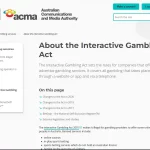
ACMA is Australia’s main online gambling regulator. Its job is not just to set out the rules: it can also act when operators breach the Interactive Gambling Act 2001. That includes issuing fines to operators and asking internet service providers to block websites.
The distinction matters when you’re trying to work out whether an online casino is safe. A site disappearing from your screen does not mean ACMA has reviewed every gambling website or approved the ones that remain accessible. Blocking is an enforcement tool, not a safety rating.
ACMA’s blocking of websites is an enforcement tool used against operators breaching the Interactive Gambling Act 2001; it is not a safety rating or a personal check of an operator.
ACMA can ask providers to block sites that offer prohibited interactive gambling services to Australian customers, as well as services aimed at adults in Australia that do not hold the required licence. The block is put in place by internet providers after ACMA makes a request. It can make a site harder to reach, but it is not a personal check of a particular operator or a guarantee about what will happen if you use it.
I used to read a site still being online as a kind of endorsement. That was a mistake. Enforcement works against services as they are identified; it does not turn every site you can open into a safe casino. Nor does a polished page or a confident claim about “trust” tell you whether ACMA has taken action.
So, if you’re looking for safe online casinos in Australia, don’t treat a list of accessible sites as proof that they are authorised or safe. ACMA’s role is to enforce the law, including through blocking requests and action against operators. It is not there to certify offshore casino sites for players.
A block is a warning about access, not a seal of approval for everything else. That’s the part I missed.
Real-Money Play: The Risk Doesn’t End With the Operator
The question I’d ask before putting real money into any online casino is not just whether the site looks “safe”. It is what happens if something goes wrong and you need someone with authority to put it right. A polished mobile site and smooth account setup can make a service feel close to home. That feeling is not the same as having Australian consumer protections behind you.
Casinos Not on BetStop in Australia: What to Know
The Interactive Gambling Act 2001 does not explicitly criminalise individual players for using offshore casino sites. That is an important distinction: the law’s position on operators is not the same as a rule that a player will be prosecuted simply for playing. But it also does not turn an offshore service into a safe or approved option. No trouble with the law is not a consumer guarantee.
The practical risk is what you may be left with if there is a dispute. An unlicensed gambling service does not provide the protections attached to a locally authorised service. If it refuses to release winnings, closes an account or handles a complaint in a way you believe is unfair, Australian laws may not help you recover the money. I would not treat a support chat, a reassuring “trusted” badge or a page of fine print as a substitute for an effective route to resolution.
That gap matters because the operator controls the account and its records. You may have screenshots and emails, but that does not mean you can make the company respond or obtain a remedy. A site can be accessible from your phone without being accountable in Australia. Looks close. Isn’t close.
I’ve made the mistake of letting a neat interface stand in for evidence. It is an easy shortcut: the site loads, the games run, and the words “secure” or “fast” create a sense that the hard questions have already been answered. They have not. A safe-looking real-money casino experience does not remove the basic uncertainty of dealing with an offshore operator outside the local protection framework.
VPN Risks
Using a VPN to bypass blocks may breach a site’s terms, leading to closed accounts, voided winnings, or lost deposits.
There is another risk if you try to get around a block with a VPN. Doing so may breach the site’s terms or trigger its location checks. The operator may close your account, void winnings or keep your deposit. A VPN does not make the service licensed in Australia, and it does not create consumer protections where they are absent. I would not risk money on the assumption that changing your apparent location will make a dispute easier to fix.
So, are online casino games safe for real money? There is no honest yes-or-no answer based on a site’s appearance alone. The important distinction is between a service that feels secure to use and one where you have meaningful protection if the operator fails you. For offshore casino play, that protection gap is part of the risk, not a technical detail you can ignore.
A “safe casino review” can describe what a reviewer saw, but it cannot promise that an operator will pay or that Australian laws will secure a remedy. Read claims with that limit in mind. If keeping control of your money and having a practical path when something goes wrong matter to you, the absence of local protections is a reason to pause rather than a small print caveat.
How to Read a Casino’s Safety Claims Without Buying the Hype
When I see a casino described as “safe”, I want to know what that word is based on. A polished page, a reassuring badge or a promise to protect players is not the same thing as a concrete security measure. The useful question is narrower: what does the site do to protect information as it moves between your device and its systems?
$5 Minimum Deposit Casinos in Australia
Casinos use SSL encryption to safeguard transactions and sensitive information. In practical terms, encryption is intended to make data travelling between your browser and the site harder for outsiders to read. That matters when personal details or payment information are being sent. It is a real security layer, not a stamp of approval for everything else the site does.
I check whether the site connection is protected in the browser, including whether the address begins with HTTPS and the browser shows its connection indicator. Then I look at the page where sensitive details would be entered, rather than assuming that a reassuring graphic on the home page tells me anything about those forms. Small check. Not a verdict.
That distinction gets lost in claims such as “trusted”, “secure” or “best safe online casino”. Those are promotional descriptions unless they point to something specific that can be checked. SSL encryption can help protect information in transit; it does not prove that every part of a service is trustworthy, that a security problem is impossible, or that a site will handle a dispute fairly. I used to treat confident wording as evidence. It isn’t.
Even the browser indicator has limits. It tells you about the connection, not whether the business behind the page deserves your confidence. A site can use encryption and still make claims you should question. So can a page that looks professional. Treat the connection check as one narrow answer, not a shortcut to calling a casino safe.
Do
- Check for HTTPS in the browser address
- Look for the connection indicator
- Verify the specific page where details are entered
Don’t
- Trust a “secure” badge on the home page
- Treat promotional wording as evidence
- Assume encryption proves a site is trustworthy
Be wary of language that blurs those boundaries. “Protected” might refer to a connection, an account feature or simply the way the site markets itself. If a claim does not say what is protected and how, you cannot assess it from the wording alone. And if a page makes a sweeping promise of complete safety, that is a reason to slow down, not a reason to relax.
For Australians, there is another boundary: encryption does not change whether a gambling service may legally be offered here. A technically protected connection is not evidence that online casino games are lawful to provide to Australian residents. Nor does a VPN make access safe or lawful; using one to reach a casino may lead to winnings being voided, an account being closed and a deposit being lost.
So, if you are trying to judge whether an online casino is safe, separate the question into parts. Is the connection encrypted? That is one check. Does the site’s wider language explain its claims rather than relying on slogans? That is another. Neither check turns a prohibited service into an acceptable choice, and neither is a guarantee against harm. “Safe” is a big word. Ask what it actually covers.
Checking a Site’s Status Before You Trust It
A site can put “licensed,” “verified” or “Australian-friendly” beside its logo. Those words are easy to display; they do not establish that the service holds a valid Australian licence. I used to treat a polished badge like a checked credential. It isn’t.
$20 Minimum Deposit Casinos in Australia
Start with ACMA’s public register. ACMA encourages Australians to use it to check whether a wagering service holds a valid Australian licence, and its website also points readers towards gambling products that are legal in Australia. Search for the service itself rather than relying on a link or screenshot supplied by the site. If the name does not appear, or the details do not match, don’t treat the site’s claim as confirmed.
There is an important distinction here: a register entry for a wagering service does not make online casino games lawful. Australian operators cannot offer real-money online casino games to people in Australia. So a page claiming to be a “safe Australian casino” should not get a pass simply because it displays a licence badge, refers to an offshore licence, or uses Australian language. Check what kind of service the register actually covers.
That check is about legal status, not a guarantee that every interaction will be trouble-free. A site’s own claims are not independent evidence. If the operator is unlicensed, you also lose the protections that come with a properly regulated service. Australian laws may not help you if the operator withholds your winnings. The word “secure” on a page cannot fix that. Different issue.
Be wary of being told to use a VPN to reach a casino or get around a block. A VPN changes how your connection appears; it does not make the service licensed in Australia or make prohibited games legal to offer here. It can also create a direct account risk: the operator may void winnings, close your account and keep your deposit. That is a steep price for hiding where you are connecting from.
Verifying a Site
Search the Register
Search for the service on ACMA’s public register rather than relying on the site’s own links.
Verify the License
Check if the name matches and what kind of service the register actually covers.
Assess the Claims
Step away if the claim cannot be verified or if the site requires a VPN for access.
If a site tells you that a VPN is required, treat that as a warning, not a clever workaround. Don’t enter payment details or send identity documents just because access works. First check the service against ACMA’s public register and read what the register says it is authorised to provide. If the claim still cannot be verified, step away rather than trying another route in.
I’d keep the checks separate: a logo is a claim, a register entry is something you can verify, and neither should be stretched to cover products the law does not allow. “Australian-friendly” is marketing, not a licence. For a real-money online casino, there is no safe Australian status to confirm by finding a badge or a foreign regulator’s name.
What Safer Play Looks Like When You’re Using a Gambling Service
A deposit limit can put a boundary around spending, but it cannot make gambling risk-free. I used to treat limits as a box to tick and then assume I had the rest handled. That was wishful thinking. A limit is useful only if you set it before you’re caught up in play and don’t keep raising it to chase losses.
One specialist review of gambling services describes deposit limits that can be set daily, weekly or monthly. Treat that as a report about the service it reviewed, not as a feature you can count on across platforms. If a service offers a limit, read what it actually controls: whether it caps deposits, how changes take effect, and whether you can keep playing with money already in the account. Don’t mistake a tool’s presence for proof that the service is safe.
No Minimum Deposit Casinos in Australia: How It Works
In Australia, online casino games cannot lawfully be offered to residents by domestic operators. Responsible-gambling features do not change that. So when a site advertises a limit as evidence that it is a “safe casino”, that word needs a hard look. A control may help manage spending; it does not establish that an online casino is authorised to serve Australians.
Look for clear information about gambling-related harm, not just a cheerful reminder to play responsibly. Reputable platforms provide harm information and direct people to professional support services across Australia. If gambling is affecting your finances, sleep, work or relationships, that is a reason to seek help rather than rely on a site’s settings. Gambling Help Online is one named support service; you can also look for professional help suited to your circumstances.
A practical check is whether the service makes its safer-play information easy to find before you deposit, and whether the options are explained in plain language. If the only prominent message is about bonuses or getting back to play, while harm information is buried or absent, I wouldn’t treat that as a reassuring sign. “Responsible” in an advert is cheap. Clear support information is more useful.
If you decide to use any gambling service, make your own boundaries away from the account screen: decide what you can afford to lose, and stop when you reach it. Don’t borrow to gamble or try to recover losses by depositing more. Those are not magic fixes; they’re ways to notice when the activity is taking more than you intended. And if you need help, reaching out is a sensible next step, not a failure.
Safer Play
- Set deposit limits before you start playing
- Seek professional help from services like Gambling Help Online if gambling affects your life
- Prioritize clear harm information over promotional bonuses
- Establish your own financial boundaries away from the account screen
Game Fairness: Check the RTP, Not the Sales Pitch
When I see a pokie described as “generous”, I look for the RTP instead. It’s a figure shown in the game’s information, not a promise about what you will get back in a session. A run of spins can go very differently; the label alone tells you nothing about your next result.
To find it, open the game and check its information or help screen. The details are often tucked behind an “i” icon or a menu. If the RTP is not there, don’t treat a promotional description as a substitute. A claim that a game is “high paying” is not the same as a clear figure you can inspect.
There’s another wrinkle that is easy to miss: one game can exist in several RTP versions. The provider may release those versions, and the operator selects which one to offer. So a figure you saw in a review, on a provider’s page or in a screenshot may not match the version in front of you. Check the game itself, rather than assuming every copy has identical settings.
That’s the detail I used to skim past. The title looked familiar, so I assumed the game was the same. Familiar name; different version.
RTP is useful for comparing the information attached to games, but it is not a safety certificate. It does not prove that a website is trustworthy, that a particular session will return anything, or that a game is suitable for you. A free-play version or a polished game screen does not change what the RTP figure means. Keep the check narrow: find the figure, confirm it belongs to the version displayed, and don’t let sales language do the explaining.
The term “safe online casino games” can blur two separate things. Game information can help you understand the version being shown; it cannot, by itself, make an online casino service safe or lawful for someone in Australia. An RTP figure is not a green light. It is one piece of information about the game, and only that.
If you cannot locate the RTP, or the displayed details are unclear, that uncertainty is worth noticing rather than filling in with a guess. I’ve learned not to let a confident banner stand in for the small print. Check the help screen. Then read what it actually says.
Identity Checks Before You Can Withdraw
KYC means “know your customer”: identity checks a gambling service uses to confirm who holds an account. A service may require verification before it will process a withdrawal, so treat it as part of the account process rather than a last-minute surprise. That said, completing KYC does not make an offshore casino legal or give you Australian consumer protection.
The documents commonly requested fall into three groups:
- Photo ID to confirm your identity.
- Proof of address to match your account details to where you live.
- Proof that you own the payment method used on the account.
The exact documents and submission steps can vary by service. Read its instructions carefully and check that the details on your account match the information in your documents. If something does not match, contact the service through its stated support channel rather than guessing what to submit. I used to treat verification as a box to tick after choosing a payment method. Better to notice the requirement before you rely on being able to withdraw.
Be cautious about what you send and where you send it. Use only the service’s stated verification process; don’t hand identity documents to someone who contacts you unexpectedly or asks for them through an unrelated channel. A polished login screen or a smooth upload process is not proof that a service is safe or legitimate.
There is also a bigger Australian context. Domestic operators are prohibited from offering online casino games to people in Australia, and unlicensed services do not provide the consumer protections you may expect. Australian laws may not help if an offshore service withholds winnings. Using a VPN to access a casino may also lead to voided winnings, account closure and loss of your deposit.
Attention: Passing KYC identity checks does not make an offshore casino legal or provide you with Australian consumer protections.
KYC is not a safety seal. It is an identity check, and passing it does not settle questions about a service’s status or what happens if there is a dispute. Before sharing sensitive documents, pause and consider whether you are comfortable with the risks of giving them to that service. Paperwork can confirm who you are. It cannot guarantee fair treatment.
PayID Deposits: Fast Transfers Don’t Guarantee Fast Withdrawals
PayID can make a deposit feel almost instant, but a quick transfer tells you very little about what happens after the money reaches a gambling account. I’ve learned to separate the speed of a payment rail from any bigger claim that a service is “safe”. One is about moving money; the other needs more than a fast notification.
PayID transfers generally use Australia’s New Payments Platform. A specialist review describes them as capable of clearing quickly, sometimes within minutes once released. That’s a useful indication of what the payment method can do, not a promise that every deposit will appear at once. The transfer may still depend on being released and processed, and the timing you see can differ from the time shown in an account.
It helps to keep the stages distinct. You initiate a transfer; it is processed through the payment system; then the receiving account has to show the credit. A notification at one stage does not necessarily confirm that every stage is complete. If the account balance has not updated, check the transaction status and the payment instructions rather than sending another transfer in a hurry. Duplicate payments are an avoidable headache.
What PayID does—and doesn’t—tell you
PayID is a way to direct a payment using a PayID identifier, such as one provided for a transfer. Its presence does not, by itself, establish that the recipient is trustworthy or that a gambling service is authorised to operate in Australia. A payment method is not a safety badge. I’d treat claims like “instant”, “secure” or “trusted” as claims to examine, not as proof.
PayID uses Australia’s New Payments Platform for fast transfers, but its presence is a payment method and not a safety badge or proof of authorization.
Before sending money, compare the recipient details shown in your banking app with the details provided for the transaction. If they do not match, stop and check. Be wary of being asked to send funds to a different recipient from the one you were given, or to follow new payment instructions sent through an unexpected message. A fast transfer can be difficult to undo once it has gone through.
Also read the payment terms closely. They may explain which account details to use and how the service records a deposit. Keep your own transaction confirmation. If the transfer leaves your bank account but is not reflected in the receiving balance, that record gives you something concrete to refer to when seeking an explanation. Don’t assume that repeating the payment will make the first one appear.
Approval is another part of the clock
The payment itself is only one part of the timing. A specialist review notes that PayID and some e-wallets can be quick after approval, while bank transfers and card payments can take several business days. Those are broad descriptions, not a guarantee for an individual transaction. Processing arrangements differ, and the word “approval” matters: money may move quickly after a request has cleared review, without the review itself being immediate.
That distinction is easy to miss when a page advertises fast payments. I used to read the headline as a promise about the whole process. It wasn’t. Ask what the stated timing refers to: the bank transfer, the account credit, or processing after approval. If the wording blurs those steps together, it tells you less than it seems to.
PayID’s speed also shouldn’t be confused with the speed of a later payout. A deposit and a withdrawal travel through different steps, and payment timing can vary by method. The next thing to check is the stated process for the transaction you actually need—not an estimate attached to a different stage.
Highest Payout Online Casino Australia: What RTP Means
A quick deposit can be convenient. It cannot settle questions about the recipient, the service, or how a later payment will be handled. Keep the confirmation, check the details before you send, and don’t let a fast transfer do the thinking for you.
Withdrawals: The Payment Method Can Set the Pace
A deposit option is not automatically a way to get money back out. I used to treat the cashier’s list like a two-way menu: if a method let me pay in, I assumed it would be there at cash-out. That assumption can leave you waiting for a route that was never available.
An affiliate-style payment review describes POLi as mainly a deposit method. So don’t count on being able to withdraw through it just because it appears beside the deposit options. Check the withdrawal terms for the specific service before treating any method as a practical cash-out route. The payment logos can be misleading.
Cards can be less straightforward too. An affiliate-style review notes that card withdrawals may be slower, or not available at all, depending on the processor. That means the answer may depend on how the service handles card payments; seeing a card brand on a page does not tell you whether it supports withdrawals. “Card accepted” is not the same as “card cash-out available”.
I’d look for the withdrawal methods and their conditions, not just the deposit page. If the terms are unclear, ask the service to confirm in writing which route it would use. Keep the reply. A vague promise from a chat window is not much comfort if you later need to resolve a disagreement.
There is a bigger Australian context here: real-money online casino games cannot legally be offered to people in Australia. A smooth-looking cashier does not change that. This is not a recommendation to use an offshore casino; payment convenience is no proof that a service is lawful or safe.
For Australians, the practical takeaway is simple: don’t assume POLi can return a withdrawal, and don’t assume a card will work for one. The method can set the pace—or rule the route out entirely. Check first. No guesswork.
What are the legal consequences for Australian players using offshore casinos?
The Interactive Gambling Act 2001 does not explicitly criminalise individual players for using offshore casino sites. ACMA can, however, seek to block prohibited services, and using an offshore site does not provide the same assurance of Australian consumer protections.
Which banking methods are available for deposits and withdrawals?
Payment options can include PayID, e-wallets, bank transfers and cards. POLi is mainly for deposits, while card withdrawals may be slower or unavailable; check which methods the service supports for each transaction type.
How long should a withdrawal take from a secure casino?
After approval, PayID and some e-wallet withdrawals can arrive quickly, sometimes within minutes. Bank transfers and card withdrawals can take several business days, and identity checks may be required before funds are released.
What responsible gambling tools and support services are available?
Licensed operators may offer daily, weekly or monthly deposit limits, and reputable platforms provide information about gambling-related harm and links to professional support services in Australia.
Casino Selection

$1 Minimum Deposit Casinos in Australia: What It Means
A stated threshold is not a playable balance: payment rules, fees and wagering terms can...

$1 Minimum Deposit Pokies in Australia: What to Know
An operator’s advertised deposit setting can differ from the payment method’s threshold, affecting whether a...

$10 Minimum Deposit Casinos in Australia
The casino’s stated minimum may not match the amount accepted by a payment provider, and...

$10 Minimum Deposit Pokies in Australia: What to Know
A low stated minimum does not guarantee every payment route accepts that amount or that...

$2 Minimum Deposit Casinos in Australia: What to Check
An operator’s cashier minimum and a payment method’s transaction floor are separate rules, and the...
$20 Minimum Deposit Casinos in Australia
A small deposit may be limited by the payment method as well as the casino,...
$20 Minimum Deposit Pokies in Australia: What to Check
A low advertised minimum can depend on the payment route, currency and bonus conditions, while...

$5 Minimum Deposit Casinos in Australia
A casino’s advertised minimum and a payment service’s limit can differ, so the cashier determines...

$5 Minimum Deposit Pokies in Australia
The casino’s stated minimum may differ from the amount its payment method or processor will...

Casinos Not on BetStop in Australia: What to Know
BetStop registration does not regulate offshore casinos, and access alone says nothing about licensing, deposits,...

Curaçao Casino Licences for Australian Players
A site’s availability, currency options and Curaçao claims do not by themselves show that it...

Highest Payout Online Casino Australia: What RTP Means
RTP describes a game’s theoretical long-run return, not the result of a session or a...

Low-Deposit Online Casinos in Australia
A practical guide to comparing operator rules, payment limits, bonuses and withdrawal conditions before choosing...

Secure Online Casinos in Australia: What to Know
Security features and payment options cannot establish that an online casino is permitted to offer...

No Minimum Deposit Casinos in Australia: How It Works
A casino may set no deposit floor, while its payment method or processor still rejects...